Whatever happened to Filipino war brides in US


 (First of two parts)
The Filipino wives of American servicemen found themselves on a US transport ship en route to America in June 1946, a month before the United States granted independence to the Philippines. The departure of the Filipino women from their homeland, which for some historians and writers evoked a romantic image of a colony and a colonizer embracing each other, ushered in a new wave of migration to the United States.
But the story of war brides, who were uprooted from their homeland in the aftermath of World War II, was largely undocumented, and the women’s sacrifices unheralded. Those women, however, left an indelible mark on the social fabric of 20th-century America.
Several studies have shown that a confluence of factors led to the emergence of Filipino war brides. The women married American servicemen called GIs in the aftermath of the war because of the population imbalance after the war, economic insecurity, racial biases, prevailing cultural norms and perceptions, and intimacy. On the whole, the intersection of gender, class and race led to the phenomenon called war brides.
They were not solely from the Philippines. From 1945 through 1965, war brides from all over the world came to America and settled there. For the Philippines, the traffic coincided with the largest wave of migration of women to the United States. I examined the policy of the US military on interracial marriages between GIs and Filipino women, the prevailing social milieu in the aftermath of the war and the racial and cultural boundaries that Filipino women had to navigate when they arrived in the highly segregated United States of America.
Study limitations
There is a dearth of available literature on Asian war brides, including Filipino women. The literature discloses little about the Asian war brides due to the absence of solid data on demographic, social and economic attributes. The data from the defunct US Immigration and Naturalization Service Agency (INS) do not distinguish between GI spouses and civilian American men who came to Asia to marry during this period. Even websites on war brides focus more on stories about European brides. No cogent explanation is offered for these rather muted voices of Asian war brides. Some war-bride accounts survive, though, scattered among books written about Filipino-Americans.
These anecdotal accounts do not provide a complete picture of the war brides’ experience. Although each bride’s experience is separate and distinct from those of others, the experiences are interrelated. And the women’s stories carry a common thread: Although married to American servicemen, they were outsiders trying to fit in.
Policy on war brides
 The United States granted independence to the Philippines in 1946, a year after the end of the war. On the eve of Philippine independence, the US Congress passed the War Brides Act of 1945 titled, “Admission of Alien Spouses and Alien Minor Children of Citizen Members of the United States Armed Forces.”
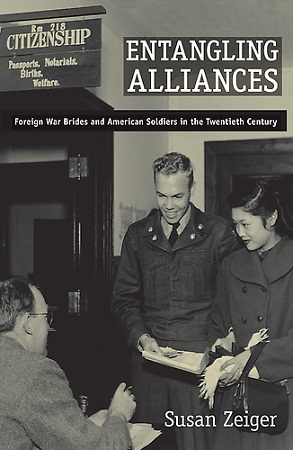
The adoption of the law was the US government’s response to the plight of thousands of women and children left by GIs around the world after the war. According to Susan Zeiger, a history professor and author of a recent book on war brides, “Entangling Alliances: Foreign War Brides and American Soldiers in the Twentieth Century,” the law declared GI spouses from both allied and enemy countries a new category of immigrant.
The War Brides Act defined war brides as “alien spouses of American soldiers who served during the war.”
America had to accept war brides brought home by GIs “as a consequence” of US foreign military engagement abroad. Of the estimated 300,000 foreign war brides, 51,747 were Filipinos.
The Philippines and Japan, which added 66,681 to the total, were the biggest sources of Asian war brides. In Europe, most war brides came from Britain and Germany.
Filipino community in US
According to Zeiger, only 2,215 Filipino women came to America under the terms of the War Brides Act. She attributed this to the “neocolonial relationship” between the United States and the Philippines that “limited the scope of marriage.” Zeiger said the newly independent country was “resentful of US power yet fearful of American abandonment and neglect.” But she asserted that this relatively small community of brides was crucial to the establishment of Filipino immigrant communities in the United States.
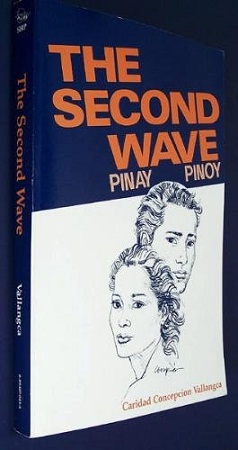
Historian Caridad Concepcion Vallangca, in her book, “The Second Wave: Pinay & Pinoy (1945-1960),” gave a much higher figure. She said that through the War Brides Act, some 118,000 GI spouses and children emigrated to the United States. Filipino spouses who arrived in the United States between 1945 and 1947 came under the terms of the act. Some brides came with their oldest child born in the Philippines. The fact that GI children born in the Philippines were also admitted under the law accounted for the varied estimates. The higher figure included the children of the foreign spouses of American men entering the United States until 1975.
The substantial presence of Filipino-Americans in the US forces that retook the Philippines from Japanese invaders in 1944 provided an opportunity for many young single Filipino-Americans to find Filipino wives. At the time, Filipino-Americans—many of whom emigrated from the Philippines to the US West Coast in the 1920s and 1930s for work and educational opportunities—were legally barred from marrying in the United States because of miscegenation laws. (Prior to the War Brides Act, the Philippines had a quota of 50 immigrants annually. Between 1901 and 1935, Filipinos could actually enter the United States without legal restrictions).
According to Zeiger, Felipe Dumlao, a noncommissioned officer in the US Army, met his future wife soon after the US forces landed in Leyte in 1944. The couple married in December 1945, and later settled in Seattle. Following the liberation of the Philippines from Japanese occupation, US Army Cpl. Ramon Partolan courted Pacita Caballes by bringing Army bread, rice and vegetables to her family. Two years after, Partolan brought his spouse to Palo Alto, in California, where the widow lives to this day.
Gender imbalance
The war left a population and gender imbalance in both the United States and the Philippines caused by the deaths of young men, and a corresponding surplus of single young women. For Filipino-American GIs, it was the first time they had encountered a surplus of teenage Filipino women. Many of the women received these GIs with open arms because the GIs were not only seen as liberators, but they also offered the Filipino women a chance to live prosperously in America.
By and large, the romance that blossomed between US servicemen and Filipino women resulted in marriages. Most of the Filipino brides married GIs who had served in the US Army’s First and Second Filipino Infantries. They settled into existing Filipino-American enclaves on the West Coast, particularly California, and Hawaii.
(To be continued)