





Philippine reefs at risk: It makes exec cry


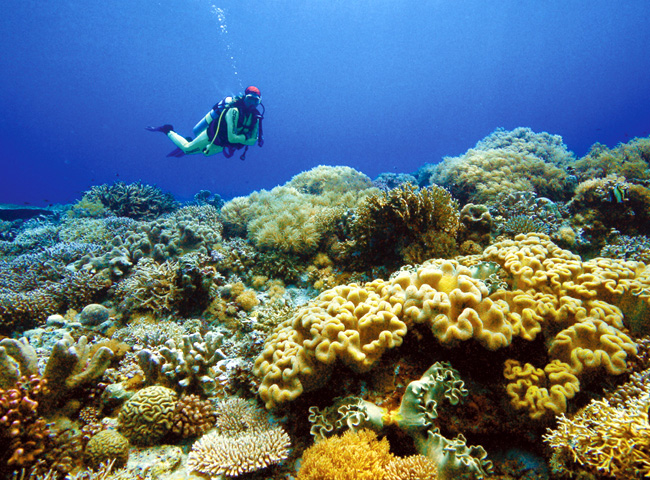
MARINE PARADISE LOST A diver fins through a field of pristine soft leather corals at the Tubbataha Reefs Natural Park. Unfortunately, only about 3 percent of the Philippine coral reefs are in “excellent condition.” YVETTE LEE / CONTRIBUTOR
Nearly all the reefs in the Coral Triangle, the waters that surround six countries in Southeast Asia and the Western Pacific, are in decline, and the Philippines is leading in reef degradation, endangering its economy and food supply.
According to a study by the World Resources Institute (WRI) called Reefs at Risk, about 85 percent of the reefs in the Coral Triangle, a biodiversity hot spot, are in peril.
The threats to the region—which covers the waters of the Philippines, Indonesia, Malaysia, Timor Leste, Papua New Guinea, and Solomon Islands—come from overfishing, watershed pollution and coastal development.
Factors such as climate change and ocean acidification increase the number of threatened reefs to 90 percent, the WRI study said.
Scientists are concerned about the Coral Triangle because the decline of the region’s coral cover is greater than the global rate of 60 percent, the study said.
“Across the Coral Triangle region, coastal communities depend on coral reefs for food, livelihoods and protection from waves during storms, but the threats to reefs in this region are incredibly high,” said Lauretta Burke, senior associate at the WRI and lead author of the study.
“Reefs are resilient—they can recover from coral bleaching and other impacts—particularly if other threats are low,” Burke said. “The benefits reefs provide are at risk, which is why concerted action to mitigate threats to reefs across the Coral Triangle region is so important,” she added.
Decline due to humans
The WRI study was released at the International Coral Research Symposium in Cairns, Australia, yesterday. About 2,500 scientists and researchers who work on coral reefs and fisheries signed a statement calling for urgent action to save the world’s coral reefs.
The statement said about 25 percent to 30 percent of the world’s reef systems were severely degraded, and this was expected to increase if local and global leaders failed to act.
“Coral reefs are important ecosystems of ecological, economic and cultural value yet they are in decline worldwide due to human activities,” the statement said. “Land-based sources of pollution, sedimentation, overfishing and climate change are the major threats, and all of them are expected to increase in severity.”
Major focus
The Coral Triangle is one of the major focus of the conference because it contains nearly 30 percent of the world’s coral reefs and more than 3,000 species of fish—twice the number found anywhere else in the world.
More than 130 million people living in the region rely on reef ecosystems for food, employment and revenue from tourism.
“The influence of coral reefs on the most important aspects of people’s lives cannot be overstated,” said Katie Reytar, research associate at the WRI. “The influence extends far beyond the Coral Triangle to people around the world who benefit from fisheries, tourism, medicines and numerous other services that reefs provide.”
The Philippines, which has the most studied reef systems in Southeast Asia, follows the regional and global decline in coral cover.
“Almost all reefs in the Philippines are threatened by local activities,” the WRI study said. “Two-thirds are rated in high or very high threat categories.”
In 2000, about 3 percent of the reefs in the Philippines were in “excellent condition,” said Protected Areas and Wildlife Bureau Director Mundita Lim, who presented the report on the Philippines’ coral reef conditions at a meeting during the symposium.
Woeful state
But as of 2010, only 1 percent of Philippine reefs were in pristine state. About 40 percent were in poor condition. “It makes me cry,” Lim said in her report.
Like the rest of Southeast Asian countries, the Philippines is struggling with overfishing, destructive fishing, oil spills and hazardous waste from agriculture and industry. Sedimentation from mining is also becoming a major problem, Lim said.
These factors are amplified by the growth in population in the Philippine coastal areas, she said.
Climate change is also destroying the country’s reefs. In 2010, a widespread coral bleaching event, which is triggered by warmer ocean temperature, happened in the Philippines.
If the public sector and the private sector failed to deal with these issues, about 55 percent of the Philippines’ reef cover would be in poor condition by 2020, Lim said.
Bleak future
The Filipinos face a bleak future because the degradation of their country’s coral reefs has an impact on food security and social stability, Lim said.
Filipinos are highly dependent on the seas, with 40 million of them living on the coasts. Seafood provides Filipinos much of their protein needs.
The tuna and seaweed sectors are also major foreign-exchange earners for the country, while coastal tourism and natural gas are emerging sources of income for the government.
The effects of the destruction of the country’s coral cover are now felt in the drop in the yield and size of fish stocks, Lim said. Fishermen have been catching less and less commercially valuable fish species such as groupers and snappers, Lim said.
Impose closed seasons
Local and foreign scientists urged the Philippines and other Coral Triangle countries to build more and bigger marine protected areas. They said managing fishing areas by imposing closed seasons, establishing “no-take areas” where fishing is not allowed, and using safe fishing methods could help revive coral reefs and increase fish stocks.
So far, less than 1 percent of the protected areas in the Coral Triangle is effective in arresting coral degradation, the WRI study said.
Alan White, a senior scientist at The Nature Conservancy who has done work in central Philippines, said that “while there is still room for improvement in increasing the effectiveness of [marine protected areas], especially large [areas] that require significant resources to manage, a lot of progress has been made in building up awareness about reef protection at the local level and in providing communities with the tools and resources to manage the reefs that they depend on.”
Originally posted: 3:59 pm | Monday, July 9th, 2012


