





ICC prosecution lays down evolution of Duterte’s Davao Death Squad


This report is part of Inquirer’s special coverage of Duterte at the ICC. For real-time updates, follow our live coverage of the confirmation hearing.
MANILA, Philippines — The prosecution has laid out its case against former President Rodrigo Duterte, presenting what it described as a roadmap of a “widespread and systematic attack” against civilians that it said began when Duterte was mayor of Davao City and continued into his presidency.
The case is based not only on body counts and public records but also on insider testimony, according to the prosecution.
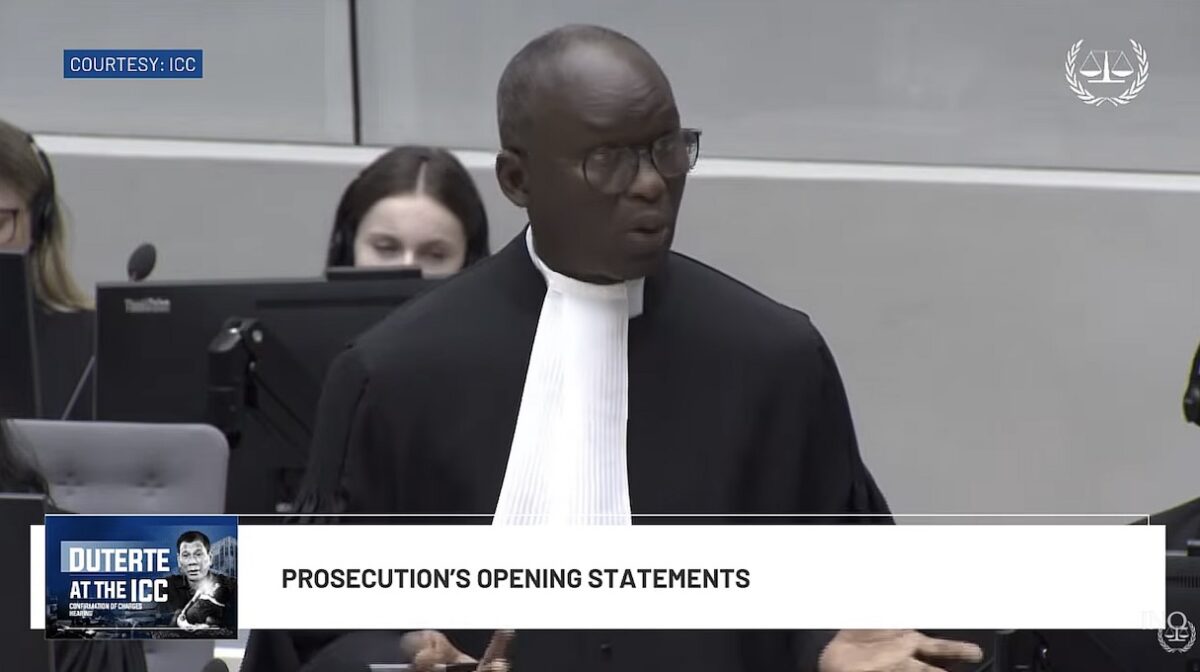
During the opening of the confirmation of charges hearing, International Criminal Court (ICC) Deputy Prosecutor Mame Mandiaye Niang cited insider witnesses, including former members of the Davao Death Squad (DDS) and police officers.
The prosecution said these witnesses described a rigid hierarchy in which a “major” hit could be carried out only upon a direct signal from the top.
Niang added that, according to one insider, “clearance” from the mayor was the final step in any execution.
Death Squad’s hierarchical pyramid-like structure
At the top of the structure is the former President who has the de jure (legal) and de facto) actual control over the Davao police. The clearance and funding come from him.
Next are the other high-ranking officials who relayed orders to the handlers, which Senior Trial Lawyer Julian Nicholls described as the co-perpetrators.
Then, the handlers who have their specific “hit” teams, and at the bottom are the direct perpetrators whom Nicholls described as made up of “both police officers who were generally lower-level police officers as well as non-police persons who were hired.“
Nicholls explained that the direct perpetrators report to the handlers who in turn report to the co-perpetrators.
“The co-perpetrators? Had different roles, but one of them was to relay orders and instructions down from Mr. Duterte to the DDS handlers and also to relay reports back up to Mr. Duterte. So a typical chain of command: the instructions go down, the reports go up,” Nicholls said.
The Davao Model as ‘Exhibit A“
During his time as mayor, Nicholls said Duterte developed a liquidation squad now known as the Davao Death Squad (DDS).
Promising a country free of criminality, Duterte cited his accomplishments in his hometown as an example.
“During his campaign to be president, Mr. Duterte expressly promised many times that he would kill criminals if elected. He claimed that the Davao was Exhibit A…He promised, he pledged, that if he won, he would expand the killings nationwide. He won. And that is what he did,” Nicholls said.
READ: Rodrigo Duterte authorized murders, ICC told as hearings open
Evolution of the Davao Death Squad
When Duterte became President, insider witnesses said an incentive structure was put in place to ensure compliance within the ranks of the Philippine National Police (PNP).
The prosecution, quoting insider witnesses, said the police were given weapons and logistics, cash rewards “per head,” and publicly naming individuals on the “watch lists” were subsequently killed.
“Some direct perpetrator complied because of their blind loyalty to Mr. Duterte, some did it out of fear and others were encouraged to comply by promises of money and rewards for some killings…that would lead to promotions and rewards,” Niang said, quoting testimonies mentioned in the prosecutor’s list of materials submitted to the court.
Niang said insiders described a “cash per head” system where financial rewards and rapid-track promotions were the primary currency for those who met killing targets.
READ: Duterte ‘maintains his innocence absolutely’ – defense lawyer
Conversely, those who hesitated, the witnesses alleged, faced a culture of fear: one insider explained that it was “simply not possible” to disobey a command originating from the President.
The prosecution is seeking to confirm three specific cases of murder and attempted murder as crimes against humanity:
- The murder of 19 victims in Davao City from 2013 to 2016 by the DDS, while Duterte was still mayor;
- The murder of 14 “high-value targets” from 2016 to 2017 by a national network of state actors; and
- The murder and attempted murder of 45 victims during a barangay clearance operation from 2016 to 2018, during which three children were also killed.
The hearing opened with a roll call of Filipino lawyers assisting Duterte’s defense team, including former Executive Secretary Salvador Medialdea and former Cabinet members Martin Delgra, Sylvestre Bello III, and Salvador Panelo.
Presiding Judge Antoanella Motoc clarified that at the confirmation of charges proceeding, Duterte’s guilt or innocence will not yet be determined. She said, the proceeding will establish if there are substantial grounds to believe the crimes were committed. /dl/cb


