





Asean lawmakers call for moratorium on deep-sea mining


MANILA, Philippines — Southeast Asian lawmakers called for an immediate moratorium on deep-sea mining, warning that the rush to extract minerals from the ocean floor could inflict irreversible damage on marine ecosystems and threaten the livelihoods of millions of people across the region.
In a statement released for Deep Day 2026, Asean Parliamentarians for Human Rights, or APHR, said the deep ocean remains “one of the least understood ecosystems on Earth,” despite playing a critical role in regulating the climate, storing carbon and sustaining marine food webs.
“The potential consequences of industrial-scale extraction in these fragile environments are profound, irreversible, and not yet fully understood,” the group said.
APHR called on governments to halt all deep-sea mining activities — including exploration and exploitation — until independent scientific research can fully determine the environmental, social and economic consequences of the emerging industry.
“Scientific evidence increasingly warns that deep-sea mining could cause widespread and long-lasting damage to marine ecosystems, including habitat destruction, species disruption, sediment plumes affecting vast areas, and noise and light pollution in ecosystems,” APHR said in its statement released Thursday, May 7.
“These risks threaten our shared ocean resources,” it added.
APHR Chair Mercy Chriesty Barends, an Indonesian lawmaker, said Southeast Asian nations could not afford to ignore the risks tied to mining the deep seabed.
“The oceans connect our nations, sustain our economies, and define our shared future. Decisions taken in international forums must reflect not only global ambitions but also regional realities and vulnerabilities. We have a duty to act with caution, foresight, and responsibility for future generations,” Barends said.
Risks to marine ecosystems
The call comes as interest in deep-sea mining intensifies globally amid growing demand for minerals such as nickel, cobalt, copper and manganese — materials used in electric vehicle batteries, renewable energy technologies and other low-carbon infrastructure.
According to a January 2026 report by the Geneva Environment Network, deep-sea mining remains in the exploration stage, with no commercial operations yet underway worldwide. Scientists and environmental groups have warned that large-scale extraction could trigger severe biodiversity loss and disrupt fragile ecosystems that remain largely unexplored.
The report noted that mining operations on the seabed could stir up massive sediment plumes capable of spreading for hundreds of kilometers, potentially smothering marine organisms and disrupting food chains. It also warned of noise and light pollution affecting species adapted to the dark and quiet conditions of the deep ocean.
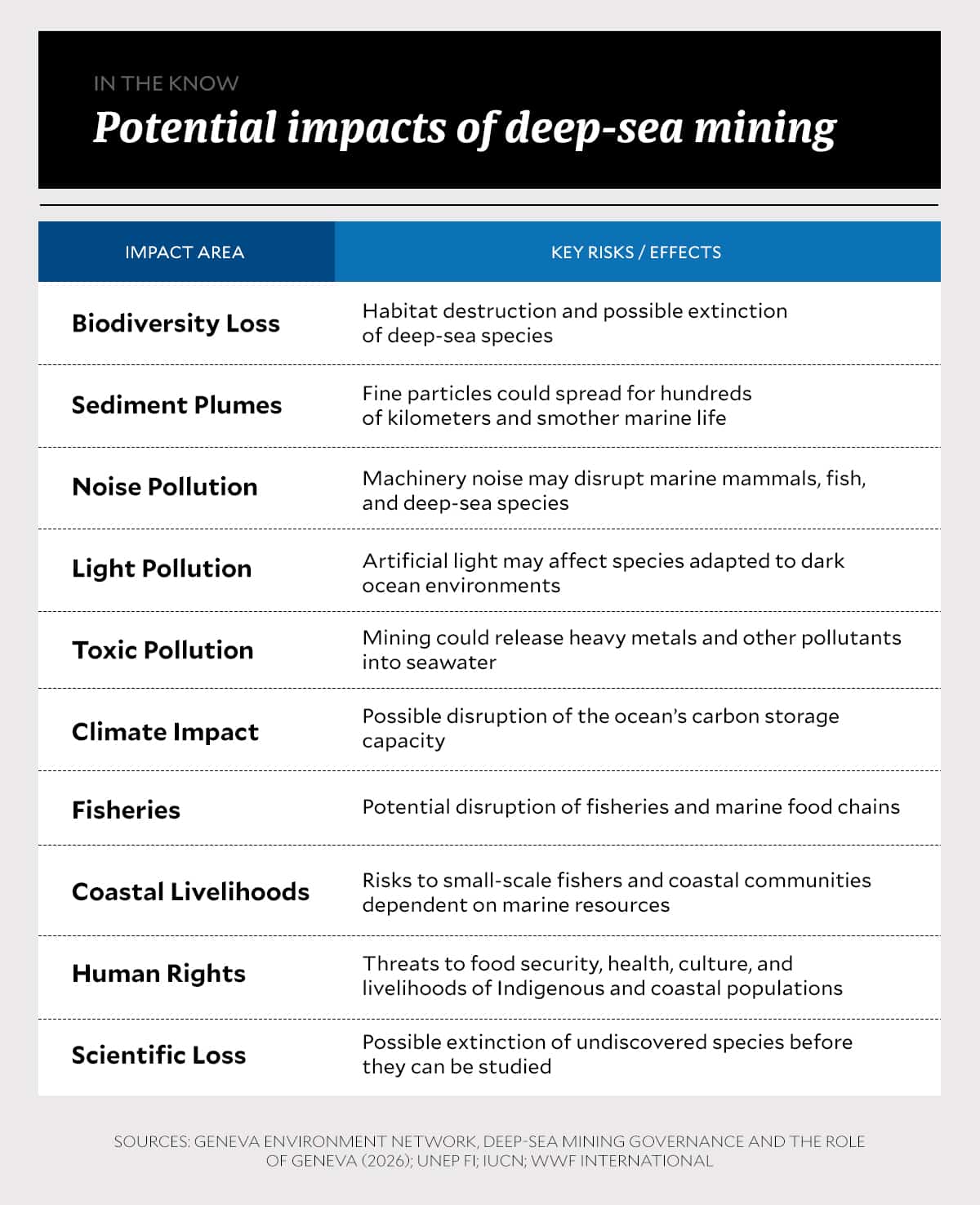
Researchers have also raised concerns over the release of toxic heavy metals into surrounding waters and the possible impact on the ocean’s ability to store carbon.
APHR said the risks carry particular urgency for Southeast Asia, which hosts some of the world’s richest marine ecosystems.
“The seas of Southeast Asia form one of the most biologically rich and economically vital marine regions in the world,” the group said. “Coral reefs, mangroves, and deep-sea ecosystems underpin food security, coastal protection, and livelihoods for hundreds of millions of people.”
RELATED STORY: SEABED QUARRYING ‘CROWDING US OUT,’ SAY MANILA BAY FISHERFOLK
The lawmakers warned that coastal communities, including small-scale fishers, are already under pressure from climate change, overfishing and pollution.
Global debate intensifies
Deep-sea mining has become one of the most contentious issues in global ocean governance.
The International Seabed Authority (ISA), the U.N.-backed body tasked with regulating mining activities in international waters, has been negotiating rules for commercial extraction for years. As of 2025, the ISA had issued 30 exploration contracts sponsored by 20 countries covering areas in the Pacific, Indian and Atlantic oceans.
The Clarion-Clipperton Zone in the Pacific Ocean has emerged as a major focus of exploration because of its vast deposits of polymetallic nodules containing nickel, cobalt, copper and manganese.
But opposition to the industry has grown steadily.
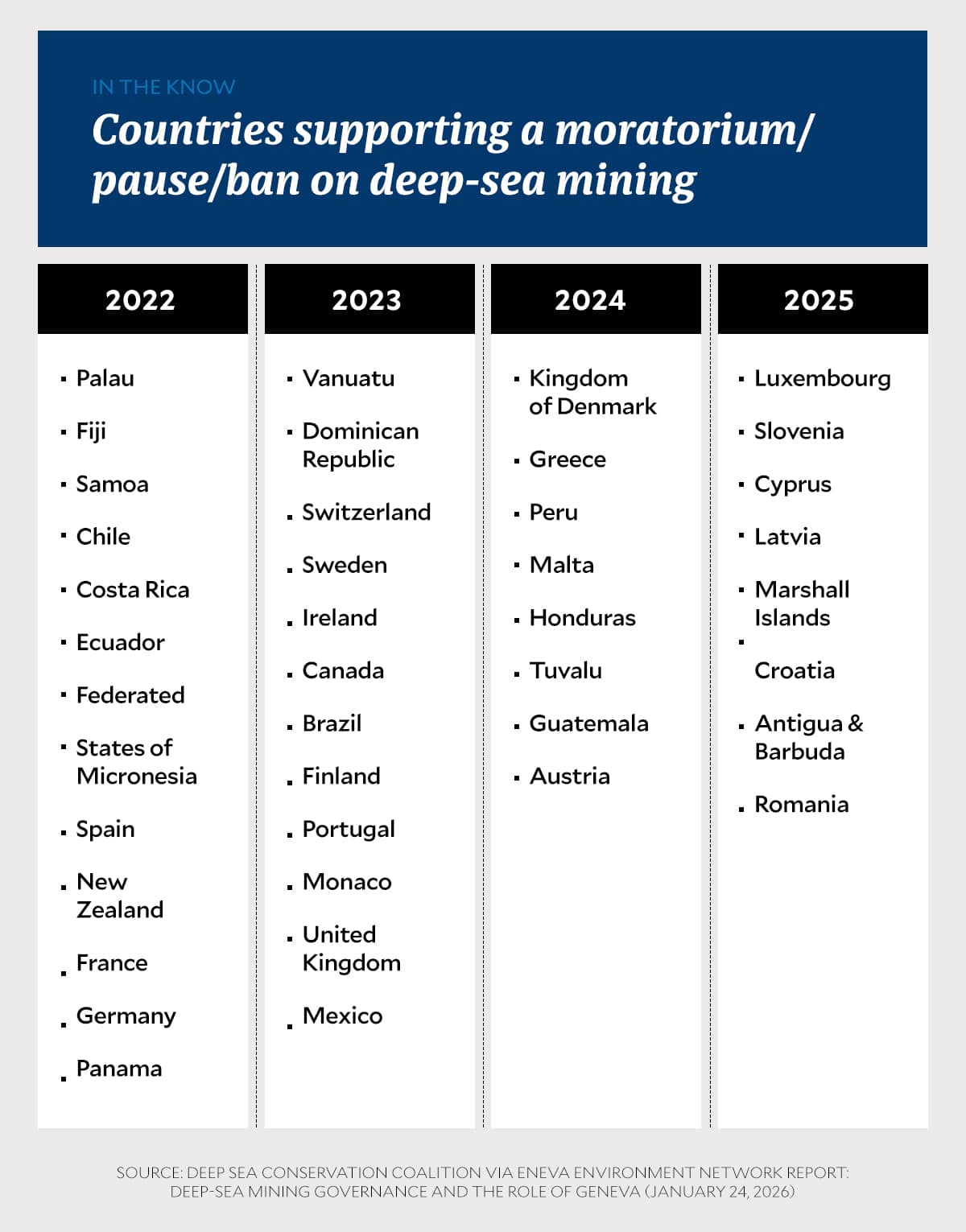
The Geneva Environment Network said dozens of countries, scientists, financial institutions and corporations have backed either a moratorium, precautionary pause or outright ban on deep-sea mining. More than 900 marine scientists and policy experts from over 70 countries have signed statements warning about the environmental risks linked to the practice.
An analysis published in 2025 by the Asia Maritime Transparency Initiative said tensions have escalated as some mining companies push for commercial extraction while governments and environmental advocates argue that regulations and scientific knowledge remain insufficient.
The issue has also become entangled in geopolitical competition over critical minerals needed for clean energy technologies.
Philippine position
The Philippines has previously expressed concern over deep-sea mining activities and the lack of scientific understanding surrounding their impacts.
During the 2023 U.N. climate talks in Dubai, then-Environment Secretary Maria Antonia Yulo Loyzaga warned about the risks posed by deep-sea mineral extraction and emphasized the need for stronger safeguards and governance.
“We wish to note with concern the lack of knowledge we have of these environments and the consequence of their physical, chemical, and biological disruption,” Loyzaga said during a COP28 side event, according to a previous Inquirer report.
READ: PH urges governments to set safeguards vs deep-sea mining activities
The Philippine government has also pushed for what officials described as a “whole-of-society approach” in discussions involving deep seabed mining exploration. In a 2023 workshop organized by the ISA in the Philippines, then-acting Foreign Affairs Secretary Charles Jose said the country wanted a “holistic strategy” for future seabed exploration and development.
Meanwhile, discussions on ocean governance have intensified following the entry into force of the High Seas Treaty — formally known as the Agreement on Biodiversity Beyond National Jurisdiction — in January 2026.
In a January 2026 commentary for the Inquirer, lawyer Noel B. Lazaro said deep-sea mining has become a major pressure point in global ocean governance because environmental baselines remain limited while commercial interest continues to grow.
READ: Why the High Seas Treaty matters
“A growing number of states and scientists call for a moratorium or precautionary pause on deep-sea mining, arguing that environmental baselines are thin and harms may be irreversible,” Lazaro wrote.
He also warned that “the race is no longer to ratify. It is to govern — before the ocean becomes yet another jurisdiction where law arrives only after the damage is irreversible.”
Calls for precaution
APHR said Asean member states have already committed themselves to biodiversity protection and climate action through agreements such as the Convention on Biological Diversity, the Paris Agreement, and the Asean Declaration on the Right to a Safe, Clean, Healthy and Sustainable Environment adopted during the 47th Asean Summit in 2025.
The lawmakers’ group said allowing deep-sea mining to proceed without sufficient scientific understanding and meaningful public consultation could undermine those commitments.

Aside from a moratorium, APHR called for stronger regional cooperation among Asean states, greater transparency in ocean governance decisions, and increased participation from scientists, civil society groups, Indigenous peoples and affected coastal communities.
The group also urged governments to invest in alternatives such as recycling technologies, resource efficiency and innovations aimed at reducing dependence on mineral extraction.
APHR said it was joining calls previously made by the U.N. high commissioner for human rights, U.N. human rights experts, and Parliamentarians for Global Action in seeking a precautionary pause on the industry.
“APHR urges the International Seabed Authority, its member states, and other non-member states to support a moratorium on deep-sea mining and to commit to protecting the integrity of our oceans and the communities who depend on them,” the group said. /dm


