





Selective application: China asserts, defies international law at once


China’s continued rejection of the 2016 arbitral decision on the South China Sea reflects not only a legal disagreement but also questions of credibility and intent, an analyst said.
Don McLain Gill, an instructor of international relations at De La Salle University, said Beijing has positioned its “narrowly driven interests above international law.”
China recognizes the United Nations Convention on the Law of the Sea (Unclos) and the obligation to uphold its provisions, but Gill said Beijing applies international law selectively—prioritizing national interest over consistent legal adherence.
As Gill told INQUIRER.net, China’s two-track stance reflects what he described as a lack of sincerity, including in being a responsible neighbor.
Rejecting the 2016 ruling
China was among the first countries to sign Unclos when it opened for signatures in 1982. China ratified the convention in 1996.
Despite this, Beijing has maintained that the decision in the arbitration case initiated by the Philippines under Annex VII of Unclos is “invalid.”
China has said the arbitral tribunal lacked authority because, it claimed, the case dealt with sovereignty and maritime delimitation, not the interpretation of the convention.
READ: 9 years after arbitral ruling, China still defies PH sea claim
“[It] gravely violated Unclos and general international law,” China said, adding that it does not accept or recognize the award “and will never accept any claim or action based on the award.”
Invoking international law against Manila
Over the years, China has repeatedly claimed the Philippines is violating Unclos and international law in defending the West Philippine Sea.
China has raised these allegations in both legal and operational contexts, from Manila’s initiation of arbitration proceedings in 2013 to maritime incidents in the South China Sea.
That approach also extended to China’s opposition to the Philippines’ Maritime Zones Act and Archipelagic Sea Lanes Act, which President Ferdinand Marcos Jr. signed to “reinforce our maritime policies.”
READ: West Philippine Sea updates
Beijing said its response was consistent with “international law and common practices,” arguing that one of the laws “illegally included” Panatag Shoal—called Huangyan Dao by China—within the Philippines’ maritime zones.
READ: China declares baselines, reaffirms opposition to PH’s new maritime law

China said the law violates its sovereignty and maritime entitlements, even though the shoal is 900 kilometers away from Hainan Island and 240 kilometers off Zambales.
READ: China opposes PH maritime zones law, says it violates territorial sovereignty
China has also claimed the Philippines’ rotational missions to the grounded BRP Sierra Madre at Ayungin Shoal, or Second Thomas Shoal—called Ren’ai Jiao by China—are illegal.
READ: China claims PH has yet to remove BRP Sierra Madre in Ayungin Shoal as promised
China’s Ministry of Natural Resources also alleged that the “illegally beached” warship “has seriously damaged the diversity, stability, and sustainability of the reef ecosystem.”
The Philippines has denied the allegations and has instead said China is violating Unclos and international law through aggressive actions in much of the South China Sea.
Unclos and ‘historic rights’
In each case, China has cited international law to support its position, but its conduct points to a broader pattern of selective application.
An edition of ASEANFocus published by the Asean Studies Centre at ISEAS-Yusof Ishak Institute noted that China participated in the nine years of negotiations that led to Unclos.
However, it said China “has interpreted and applied the provisions of the Unclos in the light of its own historical and cultural traditions.”
The publication said Unclos was intended to establish a universal body of rules to be interpreted and applied by all state signatories in the same manner.
Both China and the Philippines have accepted Unclos and the general obligation to adhere to its provisions.
The publication said it was incompatible with Unclos for China to assert “historic rights” to resources in the exclusive economic zones (EEZs) of other states based on its “nine-dash line.”
China’s claim to historic rights within the nine-, now 10-dash line, within the Philippines’ EEZ was the main reason the Philippines instituted proceedings.
The arbitral tribunal ruled that “to the extent that China claimed historic rights to resources in the waters inside its nine-dash line, such rights were extinguished when it ratified Unclos if those waters are now within the EEZs of other coastal states.”
PH on the right side
Gill told INQUIRER.net that “for the Philippines, our actions in the maritime domain are on the right side of international law.”
“It would be crucial for Manila to consistently emphasize the need to abide by Unclos and the 2016 arbitral award,” he said.
As he pointed out, “a consistent acknowledgment at the political level strengthens the Philippines’ position even more.”
RELATED STORY: Silence not an option as China encroachment persists
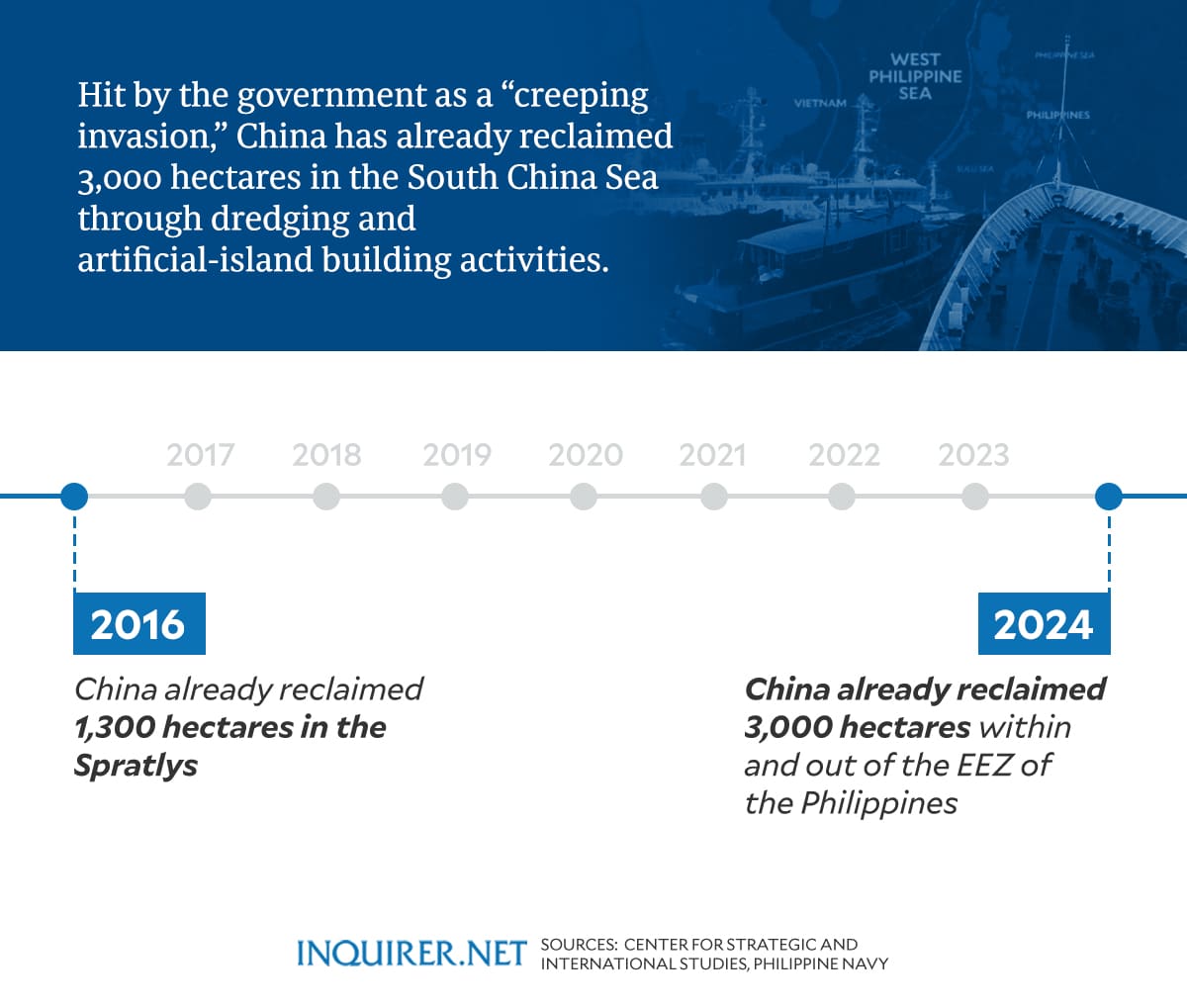
Based on data from the Asia Maritime Transparency Initiative, more than 2,500 hectares of coral reef have been destroyed by island-building activities in the South China Sea, with 75% of the damage blamed on China.
READ: China’s acts of war in West PH Sea accelerating ecological ruin
Giant clam harvesting by Chinese fishermen has also damaged an additional 6,600 hectares of coral reef.
The Philippines has also confronted a series of maritime incidents triggered by aggressive maneuvers by China Coast Guard vessels.
As the government has said, Beijing’s blocking, shadowing, and use of water cannons and military-grade lasers have heightened diplomatic strains.
China’s actions, the National Security Council said, are clearly violative of Unclos, the arbitral award and relevant international laws. /dm
For comprehensive coverage, in-depth analysis, visit our special page for West Philippine Sea updates. Stay informed with articles, videos, and expert opinions.


