


‘Kill them all’: Policy that triggered ICC case vs Rodrigo Duterte


MANILA, Philippines — Nearly a decade ago, a Davao City mayor, known for his tough-on-crime, “iron fist” image, vowed to rid the country of illegal drugs.
Months after Rodrigo Duterte was sworn in as president in 2016, that promise translated into a nationwide drug war that left thousands dead. Today, he faces charges before the International Criminal Court (ICC) as the families of the victims of the campaign continue to call for justice.
Long before today’s developments, many can recall how the former president made himself clear on his intention to eradicate the deeply-rooted illegal drug problem in the Philippines before being proclaimed chief executive — almost as violently as he could. However, it must be noted that, at the time, perhaps no one really knew the extent of how far he’d go to achieve these promises.
What it did end up becoming, however, was heavily documented by the INQUIRER.
Two months before the presidential elections in March 2016, Duterte, then still a mayor, declared outright to “kill them all” when referring to his plans against criminals and drug syndicates while campaigning for the upcoming polls.
“Kill them all,” Duterte said in one of many instances during a campaign rally in Lingayen City.
“When I become president, I’ll order the police and the military to find these people and kill them,” he added.
READ: Kill the criminals! Duterte’s vote-winning vow
Many believed him, but some argued that his pronouncements were merely part of his election campaign antics.
After all, even as he minced no words in stating such plans, Duterte often delivered his most extreme pronouncements in the same tone as his regular punch lines.
In several instances, Duterte regularly bantered with his constituents-to-be, even once jokingly — or in retrospect, maybe seriously — advising them to start building funeral parlors since he promised that they would be packed as he plans to “supply the dead bodies.”
During the launch of his presidential campaign the year before, Duterte even publicly called Pope Francis a “son of a bitch” for the traffic jams he caused during his visit to the Philippines.
This was, again, the same man who casually admitted to having not just one, but two girlfriends on top of already being in a long-term relationship with his common-law wife, Honeylet Avanceña.
What was always clear and consistent, however, was his eagerness to combat illegal drugs, going as far as declaring in the same month his plan to execute all drug criminals and syndicates, vowing to eradicate the country’s drug problem in a mere three to six months.
Among those who took his words seriously, however, were human rights watchdogs who warned of the consequences of Duterte’s rhetoric, raising alarms about the extrajudicial killings it could lead to.
Despite warnings, Duterte’s vows, no matter how vicious, effectively captured the hearts of Filipinos after he won the May 2016 elections with a landslide victory, garnering 16,601,997 votes or 39.02 percent of the 42,552,835 registered voters nationwide.
Drug war, extrajudicial killings
On June 30, 2016, the same night Duterte was declared president, at least four deaths were already logged — all tied to police buy-bust operations in various parts of the country.
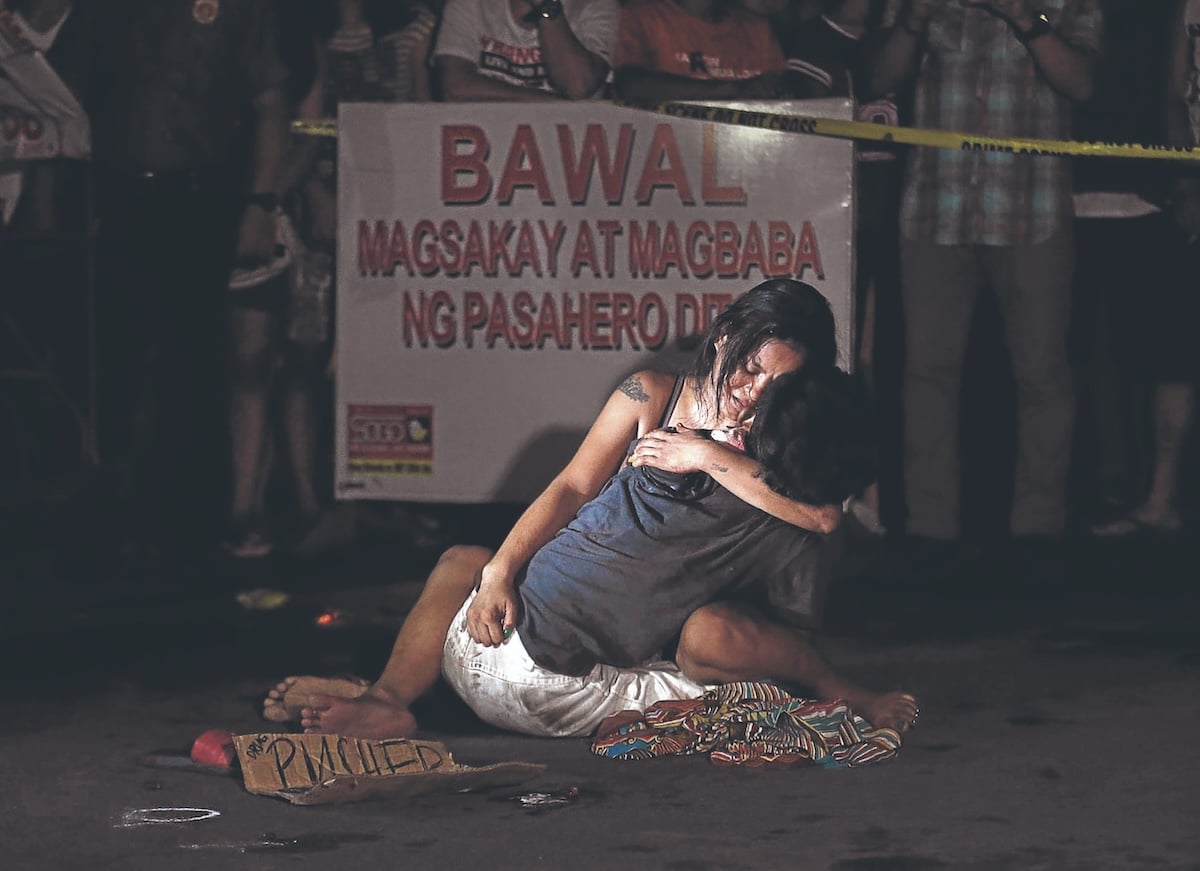
As soon as Duterte won the highest government position in the country, bodies started appearing in streets as he pushed to achieve his promise to end the proliferation of illegal drugs in the country.
Many of the dead were slumped in alleyways, others sprawled on the sidewalk, but almost all were carrying cardboard signs labeling them “drug pusher.” Not one body was given the right to due process.
In the INQUIRER’s own attempt to count the deaths in the gruesome anti-illegal drugs campaign, dubbed as “Oplan Tokhang,” 2,126 deaths — 1,104 by police and 1,022 by unknown hitmen — were tallied in Duterte’s first seven months in office.
READ: THE KILL LIST
It was also at this point that Duterte admitted that he had failed in his earlier campaign promise to rid the country of illegal drugs in a span of six months.
His answer? Extend his campaign even longer, this time up until the last day of his term in 2022.
READ: Duterte admits he was wrong on 3-6 months drug war deadline
The extension effectively meant that bodies of alleged criminals would continue to pile up, a guess that eventually proved itself to be true as the years slowly went by.
In a study conducted by the University of the Philippines in 2021, it tallied that at least two individuals were killed per day since Duterte’s anti-drug campaign started.
The study showed the years 2016, 2018, and 2021 were the bloodiest years in the campaign, with at least 3.1, 2.1, and 2.17 killed every single day during those years, respectively.
READ: Duterte drug war has killed 2 per day, says UP study
However, throughout the onslaught of Duterte’s bloody campaign against illegal drugs, the most prominent rhetoric used by the country’s security force was that these deaths were caused by suspects who fought back against arresting officers, simply known as “nanlaban.”
But families of victims argued otherwise, claiming that many killed drug pushers were either already surrendering or, worse, simply doing nothing when they were suddenly murdered.
One report from international rights watchdog Investigate PH in 2021 even accused the Philippine National Police (PNP) of covering up the circumstances of the killings during anti-drug operations.
READ: PNP continues to cover up drug war killings, obstructing justice — int’l rights group
The report cited photographs of dead victims tagged as “nanlaban” wearing handcuffs and zip ties, indicating that there was no way they could have even resisted arrest.
It also cited observations of a forensic pathologist who encountered similar indications in bodies they autopsied, bodies which showed defensive wounds not recorded by the police — wounds made by bullets that were located on the wrists of victims “who were raising their arms in front of themselves as they were shot.”
The report also pointed out that victims’ death certificates were signed by physicians closely associated with the police, drawing possible links between medical professionals and authorities in covering up these extrajudicial killings.
The PNP denied the allegations.
Meanwhile, as widespread condemnations grew from international and local human rights organizations, critics, and the public alike, Duterte consistently defended the force behind such deaths, repeatedly stating that they were merely doing their jobs by acting upon his own direct orders.
“Do your duty, and if in the process you kill 1,000 persons because you were doing duty, I will protect you. And if they try to impeach me, I will hurry up the process, and we go out of the service together,” he initially said in 2016 during a speech in Camp Crame, one of the many instances Duterte seemingly gave the country’s police force free rein to kill.
“The game is killing. I say to the human rights, I don’t give a shit with you. My order is still the same. Because I am angry,” he once again said in 2020.
Despite Duterte’s promise to protect police officers involved in his bloody campaign, a handful of authorities still ended up arrested and convicted.
The first conviction was in November 2018 when three police officers — PO3 Arnel Oares, PO1 Jeremias Pereda and PO1 Jerwin Cruz — were found guilty of murder by Branch 125 of the Caloocan City Regional Trial Court (RTC) in their involvement of Kian delos Santos’s death in August 2017, a Grade 11 student, who was killed in a police operation in Barangay 160, Caloocan City.
READ: 3 policemen guilty of killing Kian delos Santos — court
Before their conviction, police initially claimed that Delos Santos resisted and that he opened fire at them when he was apprehended. However, a closed-circuit television (CCTV) camera footage showed lawmen dragging the victim before he was found shot to death.
Meanwhile, the latest conviction was in June 2024, when four more members of the Caloocan City police— Master Sgt. Virgilio Cervantes and Corporals Arnel de Guzman, Johnston Alacre, and Artemio Saguros Jr. — were found guilty of homicide in connection with Duterte’s campaign against illegal drugs that led to the death of Luis Bonifacio and his 19-year-old son Gabriel.
Similar to Delos Santos’ case, police initially claimed that both victims fought back against arresting officers during a buy-bust operation, which resulted to their deaths. But the court sided against them, ruling that the Bonifacions had nothing to defend as the cops actually entered the house of the victims suddenly.
READ: 4 Caloocan cops in Duterte drug war found guilty of homicide
While there have been convictions involving security force personnel involved in Duterte’s bloody anti-drug operations, the 2024 case is only the fourth known conviction of all operations carried out during the Duterte years.
By the end of Duterte’s term as president in 2022, government data only acknowledged 6,000 people in the war against drugs.
However, human rights groups estimate the death toll to be as high as 30,000, while another government document, supposedly an accomplishment report, listed 20,000 dead.
READ: Duterte drug war: Thousands killed, menace stayed alive
Duterte vs ICC
Almost 10 years after his presidency began, Duterte now faces the ICC for crimes against humanity he committed during his administration’s bloody drug war.
The ICC’s involvement traces as far back as 2017, when Jude Sabio, lawyer for confessed Davao Death Squad (DDS) hitman Edgar Matobato, filed a complaint before the court in The Hague against Duterte and 11 of his loyal allies, alleging crimes against humanity, citing the “continuing mass murder” in the Philippines that began when Duterte was Davao City mayor.
This was followed by another complaint filed by former Sen. Antonio Trillanes IV and former Magdalo partylist Rep. Gary Alejano.
READ: Timeline: ICC investigation of Duterte
In February 2018, the Palace confirmed that ICC would start its “preliminary examination” on the alleged extrajudicial killings in the Philippines under Duterte’s drug war.
In response, in March 2018, Duterte announced that the Philippines would withdraw from the Rome Statute, the treaty that established the ICC, which became effective a year later.
Despite the country’s withdrawal, the ICC in September 2021 approved a formal investigation into the killings related to Duterte’s drug war.
These developments finally led to Duterte’s arrest on March 11, 2025, right upon his return from Hong Kong, this time with both the ICC and the administration of President Ferdinand Marcos Jr. maintaining that the world court had jurisdiction over crimes committed while the Philippines was still a member —from Nov. 1, 2011, to March 16, 2019.
Since then, Duterte has been in the custody of the ICC at its detention center in Scheveningen, The Hague.
READ: ICC cites reasonable grounds in issuing arrest order for Duterte
After months of legal back-and-forth — particularly over whether Duterte is fit to stand trial — between the ICC’s Pre-Trial Chamber and his defense team, the court has finally scheduled the confirmation of charges hearing for Feb. 23, 24, 26, and 27, 2026.
READ: What to know about Rodrigo Duterte’s confirmation of charges hearing
Marked as the first ever Asian leader to stand trial before the ICC, only time will be able to tell what becomes of Duterte, who continues to stand as one of the Philippines’ most (and almost inarguably, present day’s actual most) polarizing political figures. /atm
KEY ARTICLES ON DUTERTE’S ICC CASE
Rodrigo Duterte’s ICC case: Journey from Malacañang to The HaguePossible outcomes: What happens next in Duterte’s ICC case?
ON THE ICC WEBSITE


