


Filipino engineers develop prototype of suicide drone boat


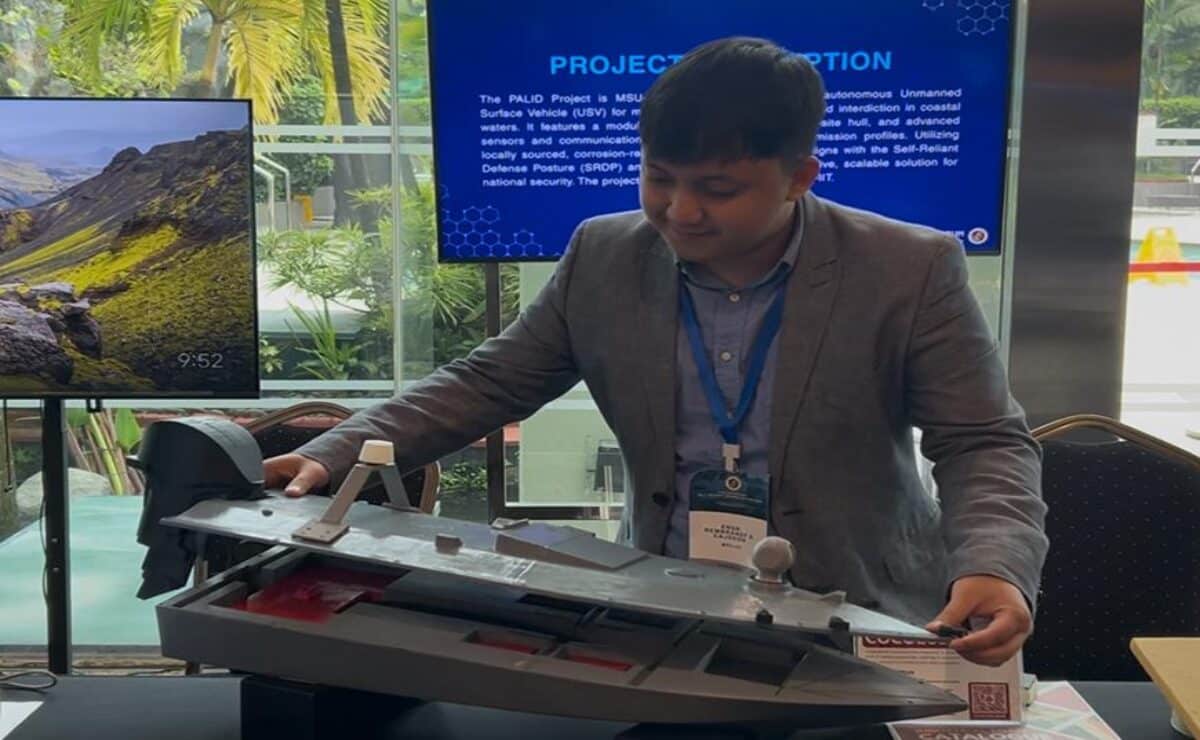
Rembrandt Cajocon, one of the engineers involved in the creation of the Philippine Autonomous Littoral Interdiction Drone, showcases the model of the locally-made unmanned surface vessel during the Philippine Navy’s Self Reliance Defense Posture forum in Pasay City on Monday, July 28, 2025. — Photo by John Eric Mendoza
MANILA, Philippines — A drone boat that is virtually indistinguishable from a civilian banca, but equipped with an unguided bomb that could inflict severe damage even to the advanced enemy warships.
This is among the capabilities of the Philippine Autonomous Littoral Interdiction Drone (Palid), an unmanned surface vessel (USV) being developed by Filipino engineers from Mindanao State University.
The model of Palid USV was displayed in the Philippine Navy’s first-ever Self Reliance Defense Posture (SRDP) summit in Manila on Wednesday.
“If you see the exhibit, it’s more about drones, because that is the thrust right now of the Philippine Navy,” said Capt. Gregory Fabic, chief naval staff for civil military operations, during the sidelines of the summit.
Fabic noted that one of the main objectives of the SRDP Revitalization Act is to support research and development of weapon systems like drones.
After receiving the research grant from the Department of Economy, Planning, and Development this month, the development of the Palid USV prototype immediately began, according to Rembrandt Cajocon, one of the engineers involved in the project.
Such a project got government support as Fabic noted that one of SRDP’s consideration is towards asymmetric warfare and even unconventional warfare.
“We cannot go conventional with, let’s say, for example, China,” said Department of National Defense Assistant Secretary Augusto Gaite, who represented the agency in the summit.
“But what would give us an edge for, let’s say, confrontation would be something like asymmetric [capabilities],” Gaite also said of drones. “So that’s the technology that we have to have.”
Boat drones level the playing field at sea by enabling weaker forces to engage more powerful adversaries, and Cajocon said its unassuming look hides its fangs.
“This is a suicide drone, but it also disguises itself like a civilian boat,” Cajocon told Inquirer. “If one sees this, one might think it’s just a normal boat.”
He said the USV will contain a dumb bomb with a 150-kilo payload that could target the enemy warship’s key capabilities.
“If the ship’s propulsion systems or radar becomes inoperable, their ships that are worth a billion dollars would be useless,” Cajocon said.
Aside from its offensive capabilities, the Palid USV could be used for surveillance as it has an unlimited communication range, thanks to the Starlink system installed in it.
The USV, which has an expected maximum displacement of 650 kilos, could hold up to 120 liters of gasoline, but it could run without one for 48 hours since it also has batteries installed.
The development of the Palid USV prototype is expected to be done within two years, according to Cajocon.
The local production of such USVs is a “good start,” according to Chester Cabalza, president and founder of the Manila-based think tank International Development and Security Cooperation.
“Drones are really a good start for our country, given that of course we cannot compete with big-ticket projects, especially when it comes to rockets and vessels,” Cabalza, one of the panelists in the forum, said during the sidelines.
“With the genius of the Filipinos in coming up and creating drones, I think we can compete in the market,” he also said, adding that the country could export such equipment in the future.
Cabalza also noted that the military’s usage of aerial drones was instrumental in its victory during the Marawi City siege.
As for USVs, the Navy is still learning their way around it.
To date, the Philippines has four T-12 Mantas USVs from the United States and the country’s personnel are still training how to operate it, according to Rear Admiral Roy Vincent Trinidad, Navy spokesperson for the West Philippine Sea.
READ: Operators of Navy’s semi-submersibles from US still in training
Trinidad said these US-made semi-submersibles arrived in the country “a few months” before former Defense Secretary Lloyd Austin III’s visit in Palawan province in November last year.
During that time, Austin said Washington would provide more T-12s to Manila under its $500 million (P29.3 billion) foreign military financing program.
Cabalza also expressed hope that the procurement of such capabilities would come with technology transfers. /das


