
Quantcast
Latest Stories

Report: Women’s lower status risk for Asian future
By

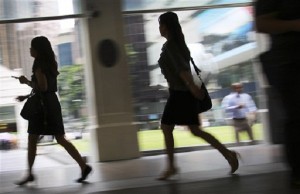
Women make their way to work during the morning rush hour out of a subway station in the heart of the Singapore financial district Thursday, April 19, 2012. The 2 billion women living in Asia are still paid less than men for similar work and are extremely underrepresented in top leadership positions, even in wealthy countries such as Japan, according to a report issued April 19, 2012. AP PHOTO/WONG MAYE-E

SHANGHAI—The 2 billion women living in Asia are still paid less than men for similar work and are extremely underrepresented in top leadership positions, even in wealthy countries such as Japan, according to a report issued Thursday.

The Asia Society survey on women’s status in health, education, economic activity and political leadership urges improvements to ensure the region benefits fully from its underused pool of human talent.

While the status of women varies widely from country to country from one category to the next, overall, “to continue in this direction would put in peril Asia’s many achievements,” said the report, compiled by Astrid S. Tuminez, a professor at the Lee Kuan Yew School of Public Policy in Singapore.

Limits on female employment cost the region $89 billion a year in terms of lost productivity and human resources, the report said, citing United Nations data.

Overall, based on various measures — the report also uses data from The Economic Forum and other sources — the gender gap was narrowest and women’s leadership strongest in New Zealand, Australia, the Philippines, Sri Lanka and Mongolia.

The gap was widest in Pakistan, Nepal, India, South Korea and Cambodia.

“Some economies in Asia with the highest human development rankings also perform most poorly in some measures of women’s leadership,” it said, referring specifically to Japan and South Korea.

Asia leads the world in terms of the number of years women have governed as heads of state, and currently has four women leaders. But the report attributes that to dynastic traditions calling for women to take over from fathers, husbands or sons when they die, are imprisoned or killed.

It said the problem begins before birth, with sex-selective abortions and infanticide due to a preference for sons in countries such as China and India.

It said the bias in favor of sons means that girls in some countries receive poorer medical care, nutrition and education than boys, especially in developing countries.

The discrepancy in schooling leaves the majority of women in four Asian nations illiterate, the report said, citing literacy rates of 10 percent in Bhutan, 16 percent in Pakistan, 25 percent in Nepal and 31 percent in Bangladesh.

Although women live longer in Asian nations as in other regions, such disadvantages affect health and earning power over a lifetime, the report noted.

“From the very start, girls in Asia face significant obstacles to fulfilling their human potential, in general, and their potential for leadership, in particular,” Asia Society President Vishakha N. Desai said in introducing the report.

Pay gaps remain significant, the report said, with the ratio of women’s pay to men’s lowest in South Korea, at 51 percent, below that of Nepal, Bangladesh and China. Japan’s was not much better, at 60 percent.

The narrowest gaps, the report found, were in Malaysia and Singapore, at 81 percent, and Mongolia and Thailand, at just under 80 percent. Globally, women’s pay is 20 percent to 30 percent less than men’s, on average.

As far as women in senior corporate positions, Japan came in worst in the region with just 5 percent of those positions held by women.

Thailand and the Philippines ranked highest in this regard, with women holding 39 percent of senior level positions, while India came in at 14 percent and China 25 percent, it said, citing a survey by human resources consultancy Grant Thornton International.

The percentage of women on corporate boards was much lower, with Japan at 0.9 percent, South Korea at 1.9 percent and China at 8.5 percent. New Zealand ranked highest, at 9.3 percent. The global average is 21 percent, down from 24 percent in 2009, the report said.

The report suggests specific countermeasures, such as providing more mentoring, more generous parental leaves, childcare and elder care, and gender-equal retirement packages would encourage women to persevere with their careers to top management positions.

But more fundamentally, it urges greater education aimed at valuing girls and women on a par with boys and men, steps to end sex selective abortions and improvement in women’s property rights and other protections to ensure they can contribute fully to society.

The Asia Society, based in New York, is a global non-profit organization seeking to promote closer ties between Asia and the West through arts, education, policy and business outreach.

Follow Elaine Kurtenbach on Twitter: http://www.twitter.com/ekurtenbachsh.


Follow Us


Follow us on Facebook Follow on Twitter Follow on Twitter


Recent Stories:

Complete stories on our Digital Edition newsstand for tablets, netbooks and mobile phones; 14-issue free trial. About to step out? Get breaking alerts on your mobile.phone. Text ON INQ BREAKING to 4467, for Globe, Smart and Sun subscribers in the Philippines.

Tags: Asia , Global Nation , Women

  • http://twitter.com/jpobar Jon Pobar

    Culture is one of the culprits here.
    Good to hear that Philippines ranked fairly in Asia in terms of women rights to hold high positions in government and corporate sectors.


Copyright © 2013, .
To subscribe to the Philippine Daily Inquirer newspaper in the Philippines, call +63 2 896-6000 for Metro Manila and Metro Cebu or email your subscription request here.
Factual errors? Contact the Philippine Daily Inquirer's day desk. Believe this article violates journalistic ethics? Contact the Inquirer's Reader's Advocate. Or write The Readers' Advocate:
c/o Philippine Daily Inquirer Chino Roces Avenue corner Yague and Mascardo Streets, Makati City, Metro Manila, Philippines Or fax nos. +63 2 8974793 to 94
Advertisement
  1. Sex in PH embassies
  2. Beijing warns PH on talks with Taipei
  3. BI to launch 6-month tourist visa next week
  4. US 7-11 stores rapped for exploiting Filipinos
  5. Filipina cries rape on cruise ship
  6. US Secretary of the Navy meets with PH defense, military officials
  7. China Sea row discussed in US officials’ call on DND
  8. Defend Philippine independence against China invasion threat
  9. US convenience stores exploited immigrants from PH, Pakistan
  10. Japan now issuing multiple-entry visas to Filipinos
  1. Only 5 in PH make list of Asia’s top universities
  2. Filipina cries rape on cruise ship
  3. NBI: Philippine coast guards liable
  4. US immigration office halts Filipina’s deportation after public outcry
  5. Tales from the deep: Fil-Am steers US submarine home
  6. Japan now issuing multiple-entry visas to Filipinos
  7. China: A superpower with no moral principles?
  8. Expert says Philippines can’t rely on US vs China
  9. DFA thanks US senators for draft resolution condemning China’s territorial claims
  10. Protest tries to stop deportation of Pinay wife of U.S. soldier
  1. Santiago: Harassment of Filipinos in Taiwan may warrant MECO abolition
  2. Only 5 in PH make list of Asia’s top universities
  3. Aquino bares AFP buildup vs ‘bullies in our backyard’
  4. ‘PH coast guards laughed while firing’
  5. Filipina cries rape on cruise ship
  6. To those who say Filipinos are stupid
  7. PCG: Video doesn’t show coast guards laughing
  8. NBI: Philippine coast guards liable
  9. Blast probe in Taguig City focuses on condo tenant
  10. PH tells China: Don’t tell us what to do within our territory

News

  • China, North Korea hold strategic talks in Beijing
  • Obama’s Berlin speech: History raises the stakes
  • ‘Emong’ maintains strength
  • Tobacco enriches, corrupts northern Philippines
  • Del Rosario, Bello meet on ‘sex for fly’ cases
  • Sports

  • Miami Heat win to force Game 7
  • NBA championship game 6 goes into overtime
  • Australia, South Korea, Iran qualify for World Cup
  • Spurs lead against Heat in halftime of game 6
  • Serena Williams comments on rape case in interview
  • Lifestyle

  • Amanda Griffin Jacob is PH’s sexiest vegan
  • Dan Brown’s ‘Inferno’ No. 1 on Apple’s iBookstore
  • 1335 A. Mabini St.–from colonial mansion to contemporary landmark
  • An expat’s ‘wife-trepreneur’s’ bright idea is fast catching on
  • Pio Abad’s art of archeology
  • Entertainment

  • Russell Brand told Katy Perry of divorce via text message
  • Jericho Rosales, Nora Aunor, Brillante Mendoza lead 36th Gawad Urian Awards
  • Hunky star, dangerous lover play with fire
  • Black Sabbath is back: Part 2 of 2
  • ‘World War Z’ draws massive crowd in NYC
  • Business

  • BOC loses bid to reverse dismissal of case vs Pilipinas Shell
  • Asian markets mixed ahead of Fed decision
  • Japan logs $10.4 billion trade deficit for May
  • US stocks surge ahead of Fed meeting
  • PAL, Cebu Pacific eye direct flights between Iloilo, Korea
  • Technology

  • Dating site for broody singles launches in Denmark
  • Facebook CEO meets SKorean president
  • Chinese supercomputer named as world’s fastest
  • Echoes can reveal the shape of a room
  • Mysterious Facebook event sparks online buzz
  • Opinion

  • Editorial cartoon, June 19, 2013
  • Missed deadlines
  • Metro Manila’s stroke
  • Gov’t should do something serious about the floods
  • Conversation with Rizal
  • Global Nation

  • Philippines sends fresh troops to disputed shoal
  • Embassy execs linked to sex ring ordered back to Manila for probe
  • Malaysia denies alleged fresh clashes in Sabah
  • US: Immigration overhaul would cut federal deficit
  • Fiji offers more than 500 troops to Golan force—diplomats
  • Marketplace
    Advertisement
    © Copyright 1997-2013 INQUIRER.net | All Rights Reserved